by Nikos Kyriakoulis (UPAT)
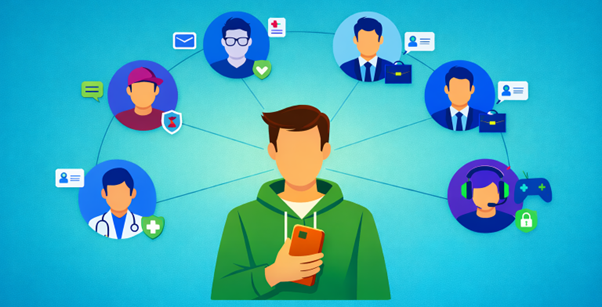
Think about how many digital identities you already have. An email account. A health record. An insurance profile. A university login. A mobile phone number. And the list goes on.
Each of these identities lives in a different system, owned by a different organisation, and managed in a different way. As a result, services cannot easily reuse verified information from other trusted sources. Users are often asked to provide the same data multiple times, while any data sharing that does occur is usually opaque and difficult to track or understand.
This fragmentation is one of the biggest hidden problems of today’s digital world. It makes everyday tasks harder for users and creates serious challenges for privacy, transparency, and consent.
This is where Identity Discovery comes in. Identity Discovery is about enabling services to find and verify identity-related information without collecting or centralising personal data, and always with the user’s knowledge and consent. Instead of repeatedly sharing documents or sensitive information, users can allow trusted organisations to confirm specific facts about them (such as age, eligibility, or address) while keeping full control over what is shared.
What is Identity Discovery
Identity Discovery answers a simple but powerful question:
“How can a service find the right identity information about me, without exposing everything about me, and without losing my control?”
Today, when a service needs information about you (e.g. your medical record), it often asks you to upload documents, create new accounts or re-enter information you have already provided elsewhere. These practices lead to oversharing of personal data, loss of transparency about who uses what, repetition and frustation etc. Identity Discovery changes this logic. Instead of moving your personal data around, it helps services discover where trusted information exists, while keeping you in the decision loop at all times.
DIMANDS2: A user-centric approach to identity discovery
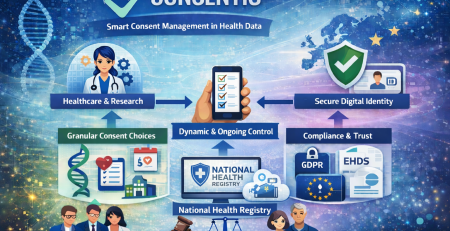
CONSENTIS is an EU-funded research project that addresses the growing complexity of identity and consent management across different services and sectors. Its objective is to enable secure, transparent, and privacy-preserving interactions between users and organizations.
The University of Patras contributes to the CONSENTIS project with DIMANDS2 [1] (Digital Identity Management and Discovery System), a discovery mechanism designed to work with existing identity systems rather than replace them. DIMANDS2 does not store personal data or introduce new global identifiers. Instead, it enables secure discovery of identity capabilities across systems, while keeping sensitive data at its original source.
For example, an insurance provider may need to verify a user’s age. With DIMANDS2, the provider does not need access to national identifiers or medical records. Instead, the system discovers which trusted authority can validate the user’s age and asks the user for approval. Only the required confirmation is shared, nothing more.
Identity discovery inside CONSENTIS
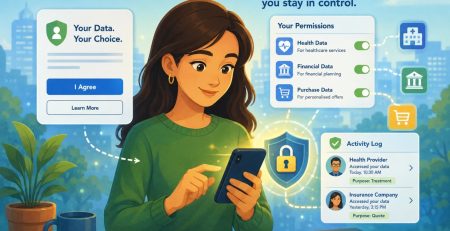
Within CONSENTIS, DIMANDS2 supports self-sovereign identity and user-centric consent management by ensuring that users remain actively involved in every identity-related request. Requests are transparently presented through a user-friendly wallet interface, allowing individuals to approve, reject, or select which trusted entity may respond. This approach reduces oversharing, increases transparency, and aligns with the General Data Protection Regulation (GDPR) [2] and emerging EU digital identity initiatives, such as eIDAS [3] and the European Digital Identity (EUDI) regulation [4].
By enabling identity discovery across domains such as healthcare and insurance, without imposing changes on existing infrastructures, DIMANDS2 helps CONSENTIS build practical, privacy-preserving identity solutions that are usable by real people, not just technical experts.
Empowering users in a connected digital future
Identity Discovery shifts digital identity from a provider-controlled process to a user-driven experience. By minimizing data exposure, improving transparency, and keeping users in control, DIMANDS2 contributes to a more trustworthy and human-centered digital ecosystem. Through CONSENTIS, the University of Patras is helping turn this vision into reality, where digital identity works seamlessly across services, while respecting privacy and user choice.
References
[1] K. Lampropoulos, N. Kyriakoulis, G. Georgakakos, and S. Denazis, “Identity management through a global discovery system based on decentralized identities,” in 2023 IEEE 28th International Workshop on Computer Aided Modeling and Design of Communication Links and Networks (CAMAD), 2023, pp. 176–181.
[2] European Parliament and Council of the European Union, Regulation (EU) 2016/679 of 27 April 2016 on the protection of natural persons with regard to the processing of personal data and on the free movement of such data, and repealing Directive 95/46/EC (General Data Protection Regulation). Official Journal of the European Union, Apr. 2016. [Online]. Available: https://eur-lex.europa.eu/eli/reg/2016/679/oj
[3] European Commission, “eIDAS Regulation,” 2025. [Online]. Available: https://digital-strategy.ec.europa.eu/en/policies/eidas-regulation.
[4] European Commission, “European Digital Identity (EUDI) Regulation,” 2025. [Online]. Available: https://digital-strategy.ec.europa.eu/en/policies/eudi-regulation.